Carson Sandell
Carson Sandell is a queer and transgender poet from San Jose, CA. They earned their MFA in Poetry from San Diego State University. They are a poetry reader for Split Lip Magazine. Their work can be found in Phoebe, The Offing, Santa Clara Review, Honey Literary, and more. Most nights you can find them curled up with a glass of wine watching trashy horror movies.
| general | |
| music | |
| movies | |
| television | |
| books | |
| heroes |
a Memory
Tell me about your favorite pair of shoes:
When I was 17, I worked as a courtesy clerk at Safeway (Vons or Albertsons for SoCal folks), cleaning bathrooms, collecting shopping carts from the corrals, and bagging groceries. With my first paycheck, I bought a pair of white Converse. I worshipped these shoes. It was my first venture into expressing / presenting myself the way I desired. I was a gay kid in the 2010s. During that time, you practically had to own a pair of Converse. It was a queer rite of passage. Every day after school, I cleaned them with a spare toothbrush and dish soap. I had them for about 3 years until the soles started peeling from the insole. I tried supergluing it back together for a little while, but one day the sole popped out, and I threw them away. Those shoes affirmed me, made me feel as though I belonged in the queer circles at school. They were almost a hanky code for us.
Tell me about your favorite car:
I’ve only owned 1 car, a Blue 2001 Honda Civic named Jason. I named him that after I got a flat tire on Friday the 13th. It was a fixer-upper. Every 2 weeks, I had to take it to the mechanic to get something repaired. The biggest problem with the car was the radiator. It broke 3 times over 5 years. The car constantly overheated, and I couldn’t drive too far, otherwise it would break down. Despite its downfalls, I did love that car. It was cramped and hot and falling apart, but I have so many fond memories and conversations. It was a place for me to sing my heart out, a sanctuary for reflection, and it granted me autonomy, a freedom to travel anywhere (within reason). In August of 2024, the transmission broke. It cost $4,000 to fix. The repair cost was significantly higher than what the car was even worth. I ended up selling to a family member for a few hundred bucks.
What was it like growing up in San Jose? What parts of the city feel like they belong to you alone? Do you have a favorite beach, mall, park, mom & pop shop?
I loved growing up in San Jose / Santa Clara. There is a richness in diversity here. When I’m in places or spaces without that, I become severely homesick. Performance and art are ingrained in the community here. The local slam and open mic scenes are the backbone of the literary community. You can spend an entire week just immersed in the art scene: art walks, music venues, museums, galleries, and art markets. Growing up surrounded by all of this art and creation, I’m sure it subconsciously made me want to pursue art myself. San Jose is massive. Each cardinal direction has its own history of architectural style, landscape, and culture. After my parents’ divorce, my mom couch surfed for a few years. On the weekends she had custody, we would stay with someone different in a different part of the city. As a child, I didn’t like this instability. Now I appreciate this variety.
When I was a teenager, I used to take the 81 bus to the end of the line, which was Vallco Mall. It was mostly abandoned except for a lone Sears and a bowling alley. There was a tranquility in wandering around a place that was practically empty. I always packed snacks and ate near the ice rink. It was a place free from the chaos of my home life. I could be myself in those brief and fleeting afternoons.
Favorite Beach:
We don’t have beaches in SJ, but favorite body of water is The Alviso Marina. Favorite California beach is San Gregorio.
Favorite Mall:
Used to be Valley Fair as a kid, but it’s way too posh and expensive now. Probably Eastridge?
Favorite Park:
Central Park in Santa Clara.
Favorite Mom & Pop Shop:
Peter’s Bakery on Alum Rock Ave.
What has changed most about San Jose in the past 10 years, or even the past 20? What parts of it never change no matter what?
So much has changed. Every time I come back home, I find out one of my favorite spots has closed. I know so many friends and families who were forced out of their homes by tech-industry gentrification. Silicon Valley is now a hub for generative AI. Data centers are being approved every single week by local legislature despite community pushback. This gentrification is contributing to the pillars of the communities leaving town or becoming unhoused. We have so many empty condos and apartments put up every single week, yet the shelters are always overcrowded and turn people away. The city has the resources to house them, but chooses not to. The thing that never changes is community members’ devotion to this city, this land, and resistance. We love this place. We cherish this place. We care for the land. We care for the health and safety of our most vulnerable, which is in direct opposition to the contemporary moment and tech futurity.
Tell me about your parents. Which parent do you see most when you look at yourself? What pieces of the other parent show up in ways you can’t deny?
This is a complicated answer. My mom was the outlier in my family. She was the most raucous, the funniest, and the most tortured. Her joy was infectious, as was her loneliness and despair. She was a fighter. She advocated for others. She also swore more than anyone I’ve ever met. My mother struggled with substance abuse her entire life, and unfortunately, it is what killed her. I love her more than I can recognize most days. We spent so many weekends in San Jose, Monterey, Modesto, Turlock, and San Juan Bautista. There were times she endangered our lives for drugs. On a few occasions, we were almost killed. Yet with all of this, she loved her children more than anything in the world. We truly were her beacon. When I look at myself, I see my mother: the outlier, the wannabe comic, the advocate, someone who struggles with the unending depths of loneliness and despair. Since transitioning, a lot of people have said I’m a carbon copy of my mother. And I’d be lying if I said I didn’t see more of my mother’s face in the mirror than my own most days.
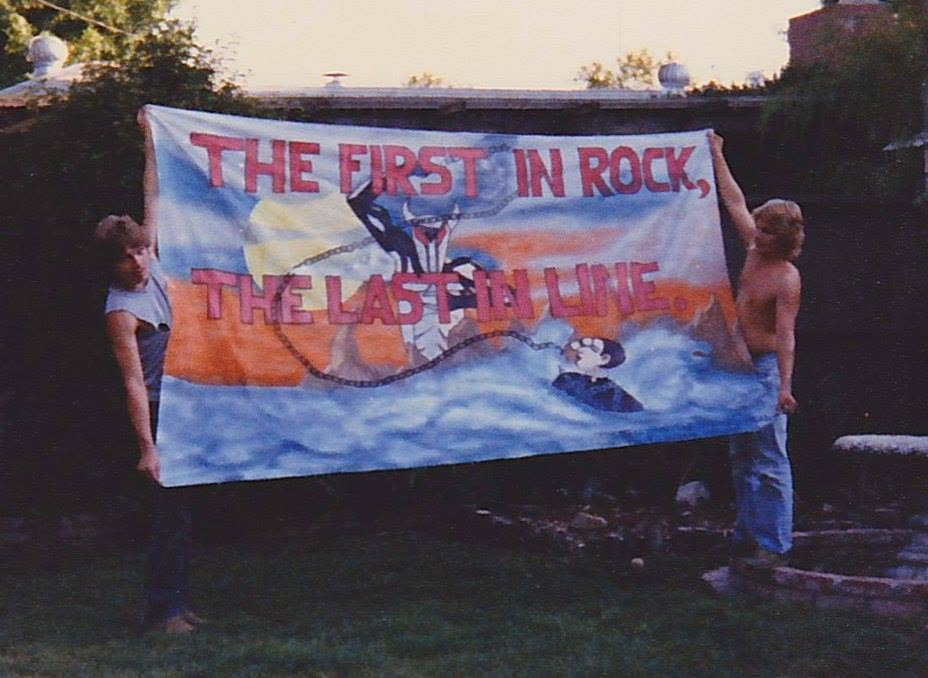
My father is a blue-collar worker. He’s a glazier, meaning he works in the glass trade and has been for around 35ish years. I do think I somehow inherited my father’s younger, artistic ambition. When he was younger, he would spray paint album art onto bed sheets. Mainly early metal and classic rock records. He took these makeshift banners to concerts, and there were times when the musicians held them up on stage. I remember he got backstage passes to meet Van Halen because they liked his banner. His favorite band is Dio. Pictured below is him (on the left) and one of his friends holding a Dio concert banner. He hasn’t created any art in a long time, but his stories and his love for music also helped shape me to be an artist early on.
What are the stories you hold about your parents’ connection to San Jose? Were they born there or did life bring them there? What was home for them?
I know my father was born in Fresno and later moved to Santa Clara in his youth. My mom was born and raised in Santa Clara. I don’t know much about either of their connections. My family tends not to share a lot. I can’t speak to my father’s feelings. However, I don’t think any place was home for my mother. She loved fresh starts. I feel that she felt that if she could only find the right place, she could get clean, she could find a new partner, she could at last be at peace. The violence done to her started here. She found love and heartbreak here. She fought to get clean at the Alano Club in San Jose. She moved away with someone she thought would bring stability and unconditional love. After that relationship dissolved, she moved back and fell hard into addiction again. And after moving back, she passed away here. The valley, much like a bed, was a site of birth, love, and death for her. I don’t think home was a physical space for my mother. She found it in other people. Her children were her home.
Tell me about that moment of transcendence that sealed your destiny as a writer:
I always say my first love was language. I started writing stories when I was six years old. I used to steal pens, pencils, and lined paper from school and write on the pages until the wetness of the ink caused them to tear. My cliché answer will be when I performed for the first time at a San Jose open mic in downtown San Jose. The open mic was hosted every Thursday at Café Frascatti, now Nirvana Soul. Hearing people snap and do that poet hum / moan to my poem gave me so much validation and courage to pursue poetry as my genre of choice.
My writer answer is I don’t have that moment. It happens every time I come to the page. The transcendence comes when I’m tapping into something within myself that needs to be concretized. The transcendence is when I’m able to enter and understand the inner mechanism of the poem. The transcendence is in the line breaks, the language crafting, the imagery, the sound and rhythms, the statements, the voice, in the reprimand, in the tender, in the anger, in the despair, in the grief, and in the joy. It is a high. The transcendence is talking to other writers, being in community with them. Destiny is passive. This isn’t destiny. This is an active choice to follow through on my art, to show up and support fellow writers, to be an active participant in the larger and local literary communities.
Who are your inspirations?
The constants are: Toni Morrison, June Jordan, Patricia Smith, Tatiana de la Tierra, James Wright, Chen Chen, Torrin a. Greathouse, Mark Doty, Layli Long Soldier, Ricky Laurentiis, and Kay Ulanday Barrett.
Newish inspirations are: Temperance Aghamohammadi, Zefyr Lisowski, GOLDEN, Kim Hyesoon, Akwaeke Emezi, Yusef Komunyakaa, Kitty Tsui, Ching-In Chen, Ally Ang, féi iká shumarí, Brigit Pegeen Kelly, and Tomas Tranströmer.
Are there any teachers, peers, familiars or strangers, that have influenced you as a writer? In what ways?
Of course. I would be nothing without the brilliance and generosity of my peers, mentors, and teachers. All of my friends in my MFA program have pushed me beyond what I thought was capable for my work. Through workshops and conversations, they gave me the confidence to experiment, to find my voice, and the courage to follow through on my scholarly work. I also want to shout out my poetry sibling Chandler Peters-Durose, who constantly makes me want to be a better poet, to be even more curious, to ask the difficult questions, and to never be artistically comfortable. I want to thank my mentors and teachers: Donnelle McGee, Blas Falconer, Allison Benis White, Rachelle Cruz, and Sara Borjas.
What was your favorite book growing up? Favorite book(s) as an adult? Recent read you loved?
Favorite book growing up: Scary Stories to Tell in the Dark
Favorite Book(s) as an adult: Jazz by Toni Morrison, Choke by Chuck Palahniuk, and Against Heaven by Kemi Alabi
Recent books I’ve loved: Battalion Shaped Girl by Temperance Aghamohammadi, Autobiography of Red by Anne Carson, and Death of The First Idea by Rickey Laurentiis
Do you have any superstitions about the writing process that you absolutely stick to? What does a writing process even look like to you?
I don’t have any superstitions. My one need is that I must be able to see the sky. The grandness, expansiveness, tunes my mind to a channel open to receiving ideas, languages, images, etc. It gets me out of my body. The skyscape allows my eyes and mind to wander and arrive at unpredictable destinations. The enormity of the sky also terrifies me. I’m scared of heights, which translates to a reluctance toward being in that vastness. I get a bad case of vertigo if I stare straight up.
My writing process is a mess. More often than not, I write when I’m struck by inspiration. And even then, I need to have the movement of the first few lines calculated, otherwise I end up staring at a blank page for an indeterminate amount of time. This is not a sustainable art practice. I want to be the writer who has a set routine. Although I’m not that person at the moment, I’m slowly working towards that ritual.
What crafts and hobbies do you love and take part in? Is there a specific craft or hobby you are proud of that many people might not know about you?
I’m a huge horror movie nerd. When I’m not reading or writing, I fill my time with horror movies from varying eras and varying subgenres. I started my foray into horror at 6 when my mother put on Puppet Master while she folded clothes. And over the years, we bonded over anything and everything horror. I’m just a movie lover in general. If it’s not horror I’m watching it’s typically underground queer cinema. I love film just as much as I love poetry. As an artist, it’s so important to draw inspiration and influence from other genres and mediums. Film remains, and will forever be, a leading influence on my art.
What question do you wish people asked about your writing or your life that they rarely do?
For my writing, I wish people asked more about how my trans and queer embodiments show up not only in content, but also in how they shape forms or modes. I’m a nerd about queer and trans poetics, so any opportunity to discuss the possibilities of queering or transing I’m always excited for.
For my life, I wished people asked me about the harmonica (it’s my favorite instrument) because when I hear that beautiful screeching, that metallic cry, I feel alive again. I used to play the harmonica regularly, but it’s hard to find the time to practice nowadays. I do hope to return to it again someday.
As a reader of poetry, what do you wish to see more of? What boundaries do you wish people would push? What do you wish people would stop doing?
I want poets to write more sestinas. It’s my favorite form, so there is selfishness involved. However, I find the sestina lends itself to queering and transing. I feel this form hasn’t been pushed as far as it can, and a lot of that has to do with the sestina being such an intimidating and sometimes miserable form. I always struggled with villanelles, ghazals, pantoums, duplexes, essentially anything with refrains or repetitions. Somehow, I feel comfortable in the sestina when given my track record, I shouldn’t. It’s a bizarre contradiction.
I want to see more stuffy, academic page poets embrace the oral tradition more. I come from slam and spoken word roots, and the elitism and shaming a lot of academic poets have for oral poets is abysmal. It prioritizes the written word over the spoken. People view spoken word and slam as lesser, as childish. Considering poetry was born out of oral tradition, this severing is really just a sad denial of our art form’s history. Slam has been mocked by the media and other poets, and it continues to be misrepresented in academic circles. It’s always the people mocking it, shaming it, that 1. have never been to a slam competition and 2. would never get up there and perform. I wish they would perform so they could realize just how hard and demanding, but also exhilarating slam is. If we’re being honest, a lot of these stuffy academic poets lack energy, conviction, and any sense of identity when they read.
You are from San Jose, the most populated city in Northern California. You have also lived in Riverside and San Diego in Southern California. How would you begin to describe the scale of California? How do the two hemispheres differ?
One of the many things I love about California is the biodiversity. Northern California feels dramatically different than Southern California. California feels like 5 states in one. From San Diego, you can drive six hours north, and you will be about halfway through the state (if the traffic is not too bad). Culturally, even geologically, every city I’ve lived in doesn’t compare to the next. San Jose feels nothing like Riverside, and Riverside feels nothing like San Diego. The way people interact with you also changes from region to region, as does dialect. It’s so fun talking to someone from San Diego or Riverside or anywhere in SoCal and noticing the name for something dynamically changes. My best friend EM and I once had a conversation about what the name of the MTS trolley is. Here in SD, most people say the Trolley. Back home in SJ, most people say the light rail. The same goes for freeways. SoCal folks add “the” before a freeway name. In NorCal, we drop “the” altogether. I love these subtle regional differences.
One thing I really admire about your work is that it is written in an Americana style that feels incredibly Californian in unexpected ways. What were your goals when recreating this landscape in your poetry?
Thank you! I apologize for such a long answer and temporary digression. Following the passing of my mother, I turned to the natural world to make sense of this grief. It just so happened around this time that I reached for poets writing about the beautiful expansiveness and the human-made wreckage of flora and fauna. With this collection, I never set out to write about the landscapes I witnessed and lived in. It organically sprouted throughout the work. California is diverse geographically. You have dense forests, gorgeous deserts, waterfalls, sandy beaches, stony beaches, marshlands, wind-swept meadows, and so much more. I fell in love with this biome variety as a child. When I recalled memories with my mother, what kept showing up was this biodiversity. I figured I would write an ode to this landscape and land. To me, it held all the complexities, joy, and contradictions of grief and loss. It didn’t give me the answers, as there isn’t a single answer to or relief for grief.
Embedded in the California landscape is all this decaying Americana. It’s everywhere. I wouldn’t necessarily say my style is Americana, as I reject the concept of Americana and what it represents. Americana, especially romanticized imagery, is used by fascists to conjure a nostalgia for a “better” era in this nation’s history. There was never a good America. I drew from the imagery around me, the images forced upon me as a child; imagery I was taught to love and cherish and idolize without question. Which, to me, felt similar to my strained relationship with my mother.
If you were a flower, where would you grow?
If I was a flower, I would grow inside Amboy Crater.
What would you write in a letter to the San Jose of your childhood, and what would you write in a letter to the San Jose of the future?
Dear San Jose of the past and to the barrier wall outside my childhood duplex, do you remember when you were shoe-scuffed and paintless? Do you still remember the warmth of my body as I sat waiting for my brother to walk home from middle school wrestling? For his body to interrupt the visage of the twilight sun. You are now painted a soulless white. I want to ask how you feel about this makeover, but you have not arrived at the present yet. Will you write me a letter when you do? I remember my first sip of beer as a child in the Motel 6 off Fontaine. I remember my first of-age drink at Renegades off Taylor and Coleman, right beside my father’s glass shop. Do you hear the children yelling and screaming in the street? Hold tight to that sound. Do you feel how full of life you are? Do you feel how full of death you are? My beloved, get some rest because you’re going to need it.
Dear San Jose of the future, I hope we stay even more committed to resistance and collective liberation, that we never lose sight of or abandon our most vulnerable. Stay radical.